
By Professor Adriana Vazquez
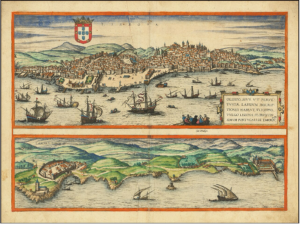
Beneath the historic buildings of Lisbon lies a secret history, archaeological in conceit but nowhere to be found in its stratigraphy: the cobbled streets and signature tiled buildings of contemporary Lisbon cover over the remains of a city named Ulisseia. The city was said to have been founded by Odysseus and can be called, in archaeological terms, the first phase of Portugal’s capital. The full story goes that the Greek hero, among his many diversions along the course of his famed homecoming following the fall of Troy, sailed up the Tagus River, engaged in an affair with a local royal maiden, and founded a city in his name before continuing on to Ithaca. Yet, no matter how deep she should dig, no archaeologist will ever uncover Ulisseia’s traces: the city exists only in our literature.
This side quest falls within the ambit of Homer’s Odyssey, the exemplary story of Odysseus’ homecoming journey; and yet, keen readers of the epic have long recognized that there is no place in Homer for such an episode. Nowhere in the Odyssey do Odysseus and his men land at a site which could, by any accounting, be mapped onto modern-day Portugal. Instead, we have to look to alternate, supplementary sources if we want to scratch the itch of ancient authorization: writers such as Pomponius Mela, Pliny the Elder, and Strabo confidently assert Odysseus’ activity on the Iberian Peninsula. The man responsible for cherry-picking their geographic accounts—where the story of Ulisseia is a minor buried detail—is the Portuguese scholar and humanist, André de Resende, who unearthed the literary traces of Ulisseia for his 16th century opening address to commemorate the start of the academic year at the University of Lisbon. He additionally validated the account with the identification of a Roman inscription seemingly confirming the ancient site of a Roman city named Olisippo—tantalizing for its tangibility. The story became an instant classic among Portuguese learned society and, in its popularity, it generated two Portuguese epics on the theme in the following century, the Ulisseia, ou Lisboa edificada (“Ulisseia, or, the Foundation of Lisbon”) of Gabriel Pereira de Castro and the Ulyssippo, Poema Heroico (“Ulyssippo, an Epic Poem”) of Antonio de Sousa de Macedo. Scholarship on both poems reveals how indebted they are to Homer, in spite of their contradicting him.
The inscription was later determined to be forged; just as we search in Homer for verification, only to be met with the problem of omission, Ulisseia becomes increasingly vacuous. If we commit ourselves to the myth of Lisbon’s origin, we do so in spite of the Homeric lacuna, by which we participate in nothing less than his desacralization, or at least, the dethroning of the Odyssey as some kind of definitive narrative. To judge Homer by the accounts of his successors reverses the direction of reading, holding him up to an anachronistic scrutiny. As generous readers, we will not go so far as asserting that Homer made a mistake out of ignorance or carelessness. Instead, we will explain Homer’s silence according to the limits of epic performance (‘there is only so much story one can tell at any given opportunity’), and its expansivity: Homer left this story, among many others, for a different bard and a different song.
This unusual moment of Homeric reception, one hardly prompted by Homer himself or explained by his text, retains much of its appeal and generates reflections on the capacities of reception itself. What are the limits to epic malleability? Are there receptions and interpretations that ‘go too far’? Can we really buy into the idea of an Odyssean Lisbon, or a Portuguese Odysseus? Certain aspects of the Trojan epic cycle appear inviolable: it is hard to imagine, for instance, a version of the story in which the Trojans are victorious or in which Hector manages to slay Achilles. But every version of the story contains apertures for innovation: in which case, why couldn’t Odysseus have arrived in Portugal? Now, we rationalize: a decade is a long time for a journey; surely, in all of his coursings through the Mediterranean, there could have been time for a quick stop along the Tagus, for an encounter with a Portuguese version of Nausicaa, and for city foundation, an activity ascribed to so many traveling Greek heroes, such as Herakles. And so, we buy into the myth of Ulisseia, concluding that what Homer never knew, won’t succeed in killing him.